
Freshwater flushing at the touch of a button
Protect the systems that keep your vessel running
PHIBER Systems purge seawater from engines, generators, watermakers, and gyros — automatically, on a schedule, or on demand. PYM configures and installs the system around your boat.
What is PHIBER?
Preservative maintenance for seawater systems
Anything on a boat that uses seawater will scale, corrode, and foul. Manufacturers of engines, generators, watermakers, and stabilizers all say the same thing: flush with freshwater. That is the single most important preventative step — and the one crews skip because a manual flush is slow, awkward, and easy to get wrong.
PHIBER replaces the dock hose. A manifold and Control Module, programmed to the vessel, inject freshwater at the right moment, purge the raw-water circuit, and leave it pickled with freshwater instead of salt.
Compatible with most marine inboard and outboard engines, generators, desalination systems, gyros, and more. Optimal results, every cycle.
Marine applications
One architecture. The systems that actually need it.
Open each application for how PYM typically specifies a PHIBER install. Deeper engineering lives on the PHIBER marine applications pages.
Inboard Propulsion Engines
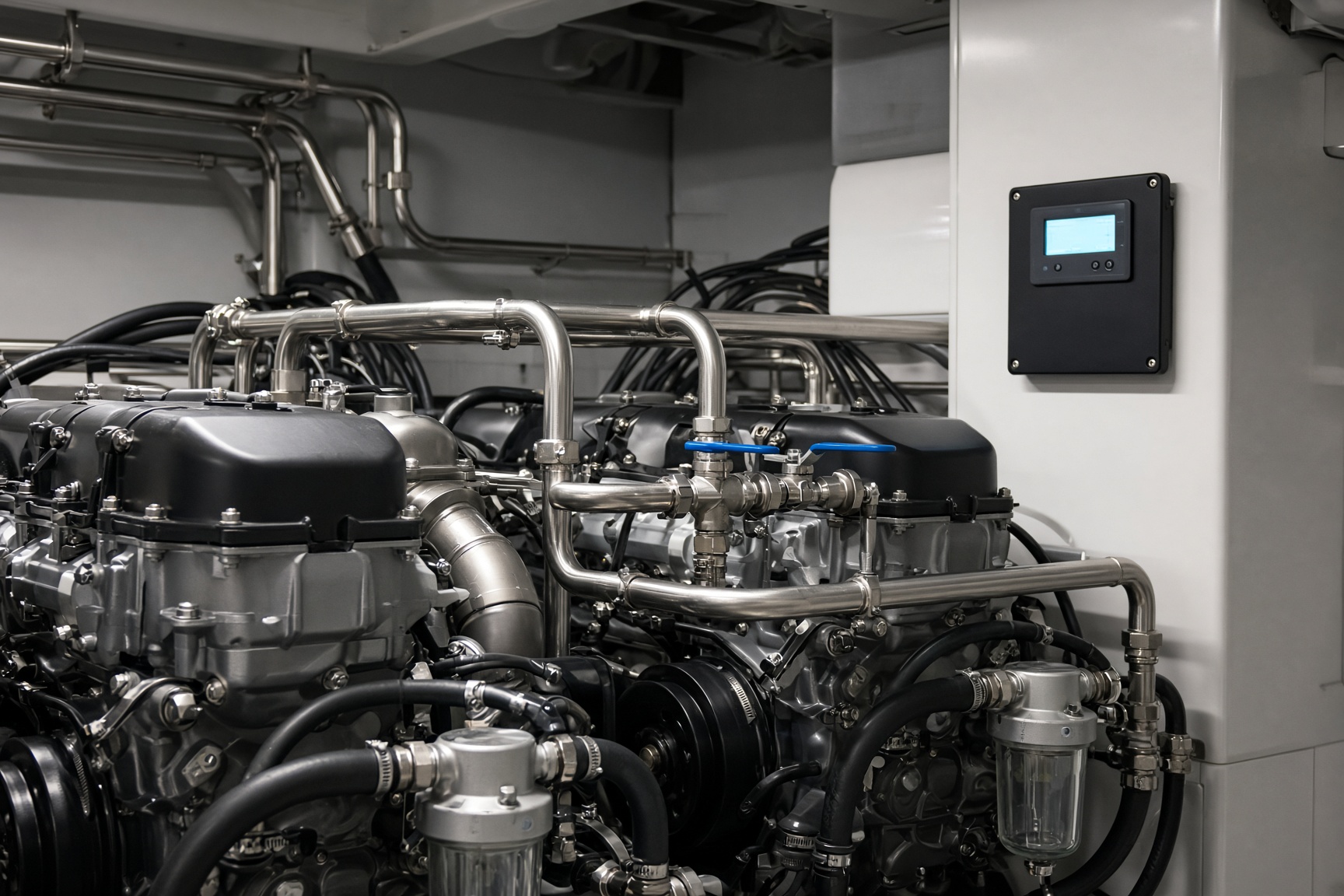
When an inboard shuts down, residual heat cooks the seawater left in the block and heat exchangers. Minerals and biologics drop out of solution and plate onto the surfaces that keep the engine cool. That is the origin story of most overheating jobs.
A correctly sized PHIBER manifold and Control Module inject freshwater at the right moment, displace the seawater, and pickle the raw-water circuit before shutdown. Done at operating temperature, most inboards do not need a large volume of water — only enough to purge the circuit.
Flow rate, circuit volume, and the time required to reach an acceptable salinity (PPM) set the flush. On many boats the vessel’s own freshwater pump is enough; high-performance or large-displacement engines may need a dedicated feed pump.
Outboard Propulsion Engines
Setup, flush, and breakdown is typically a quarter-hour per engine. OEM times assume unknown conditions: a cold engine, unknown dock pressure, possible scale already in the circuit. PHIBER removes the guesswork and the hose.
Flush at the end of the run, while the thermostat is still open, and you use far less water. Multiple engines can flush together or in sequence through a multi-valve layout. Most modern outboards already have a flush port under the cowl; if they do not, the circuit can still be tied in cleanly.
Installations can sit out of sight with almost no deck footprint, which matters on yachts where the engine cowling is part of the aesthetic.
Generators
Because of that, generator freshwater flushes usually get postponed until seasonal service or a chemical treatment. Scale and corrosion do not wait for the calendar.
PHIBER treats a generator like the inboard it is: the manifold and Control Module run a safe, correctly timed flush automatically or on demand, pickling the raw-water circuit at the end of the run.
Sizing follows the same rules as propulsion — flow, volume, and duration — with a dedicated feed pump only when the house freshwater system cannot keep up.
Water Desalination Systems
Unlike engines, watermakers can use either the inboard or overboard manifold. Choose inboard if you want the entire raw-water intake network flushed; choose overboard if only the watermaker itself needs protection.
Membranes do not need much water. The flush dilutes and displaces seawater, then stops. During long idle periods, a scheduled cycle keeps the membrane preserved without anyone remembering to do it.
Gyroscopic Stabilization Systems
That makes them a straightforward PHIBER install. Use the inboard manifold if the vessel stays in the water between runs. Use overboard if she lives on a lift or trailer.
Flush while the gyro is still warm and you only use the water required to displace the seawater in the circuit. Same Control Module, same logged history, same one-button operation as the rest of the boat.
Why PHIBER?
Seven reasons the hose loses
Mitigate corrosion
Purge seawater from raw-water circuits so salt is not left sitting in heat exchangers, blocks, and coolers after shutdown.
Reduce biofouling & scale
Routine freshwater displacement slows mineral scale and biological growth that choke cooling passages and drive overheating.
Streamline the flush
No dock hose, no seacock gymnastics, no 15-minute-per-engine ritual. Flush from the vessel’s own freshwater system.
Log critical maintenance
The Control Module records flush history on an SD card — useful for service records, resale, and compliance.
Limit invasive species transfer
Flushing raw-water networks with freshwater helps reduce the hitchhikers that travel with seawater between regions.
Protect vital systems
One architecture covers engines, generators, watermakers, gyros, and other seawater-cooled equipment on the vessel.
Lower cost of ownership
Preservative maintenance is cheaper than heat-exchanger jobs, impeller failures, and lost season time.
How PHIBER works
Three ways to run a perfect flush
Automatic
Flushing can fire from programmed vessel functions — for example at the end of a run cycle, while the system is still near operating temperature.
Scheduled
Set routine intervals around the vessel’s maintenance plan, including idle periods when a watermaker membrane still needs protection.
On Demand
Press the button. A precision freshwater flush runs when you want it, without rolling out a dock hose.
Preservative maintenance
Protect it before it fails
PHIBER routinely purges seawater from the vessel’s raw-water systems and replaces it with freshwater. That slows corrosion, biofouling, and scale — instead of waiting for a heat exchanger, a membrane, or a season to be lost. The goal is not a better repair. It is fewer repairs.
Why PYM?
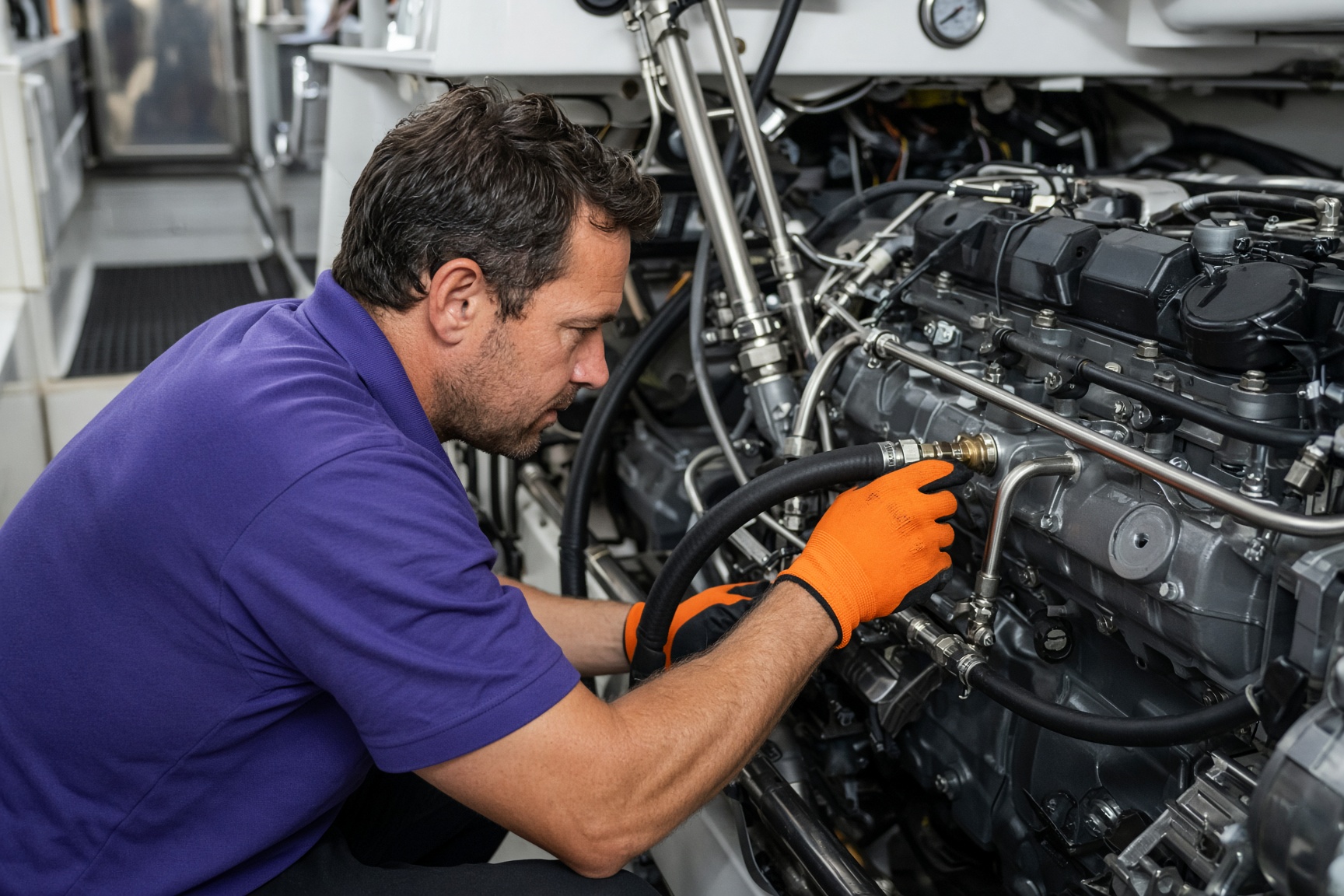
Certified installer. Vessel-specific work.
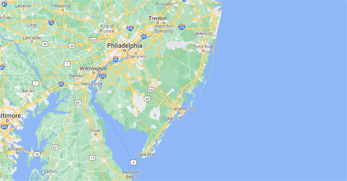
PYM selects, configures, and installs PHIBER around the raw-water systems actually on your boat — in New Jersey, South Florida, and the waters in between.
-
Certified PHIBER Systems installer
PYM is a certified installer in New Jersey, South Florida, and surrounding waters — not a catalog reseller.
-
Vessel-specific configuration
We size and program the manifold and Control Module around your actual raw-water systems, not a generic kit.
-
Professional marine installation
Hose runs, feed pumps, safety interlocks, and finish work are done to the same standard as the rest of our yacht work.
-
Multiple systems, one installer
Engines, generators, watermakers, gyros — we can protect the whole raw-water picture instead of leaving orphan systems on a hose.
Protect your vessel
Make freshwater flushing part of the routine
Tell us about the boat. We will come back with a configuration that fits the systems you actually run — not a generic kit.
Mullica Hill, NJ · Stuart, FL · Canyon Club, Stone Harbor, Dredge Harbor, MarineMax Island, and surrounding marinas.
PHIBER® and related marks are trademarks of PHIBER Systems. Premier Yacht Management is a certified installer and is not the manufacturer. For deeper engineering detail, visit phibersystems.com.